The Rebel Machine Was AMC at Its Boldest
For one model year Kenosha built a 340 horsepower red, white and blue statement that refused to apologize for the badge on its nose.
For one model year Kenosha built a 340 horsepower red, white and blue statement that refused to apologize for the badge on its nose.
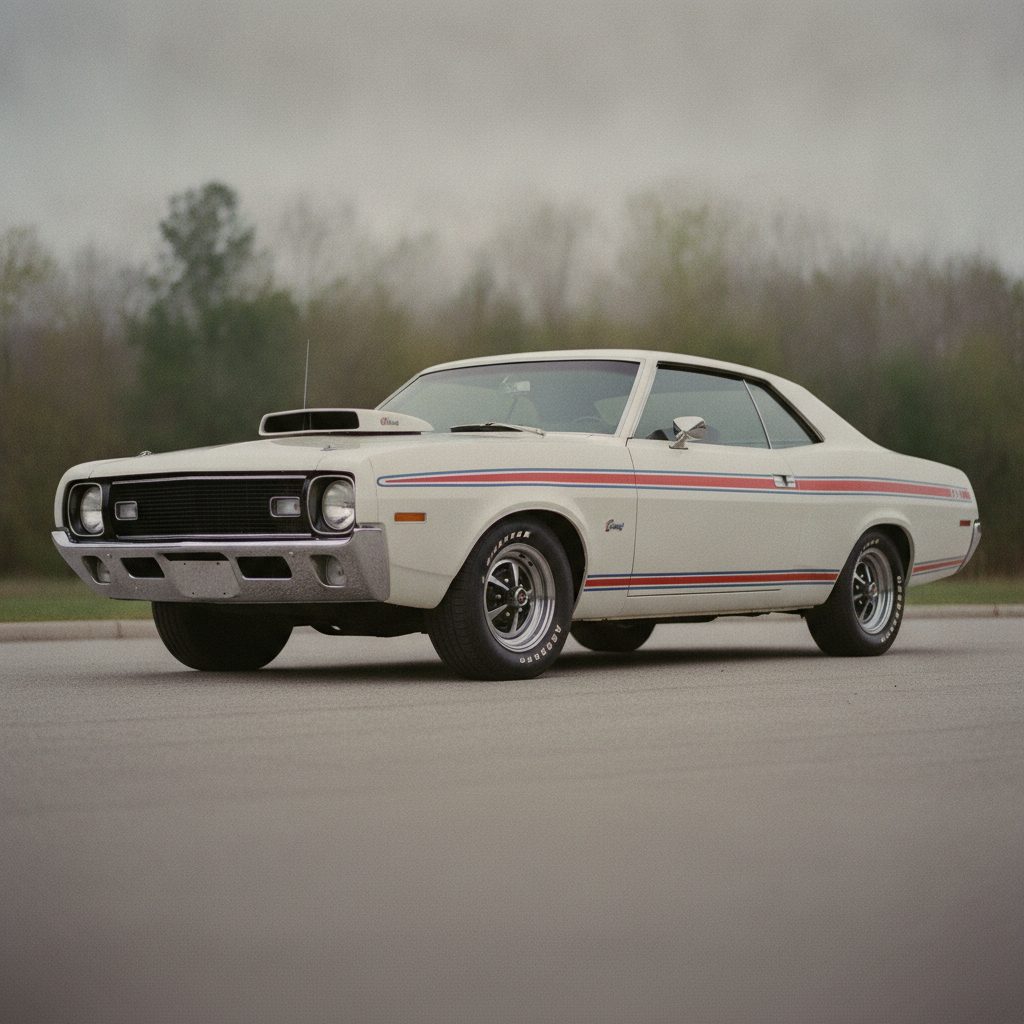
Every muscle car era has a company that could not afford to play the game and played it anyway. In 1970 that company was American Motors, and the proof was a two-door Rebel hardtop wearing enough red and blue paint to make a fire truck feel underdressed. AMC called it The Machine. It lasted a single model year, and it remains one of the most honest cars Detroit's fourth wheel ever built.
The Machine did not come out of nowhere. A year earlier, AMC and Hurst had stuffed the 390 into a compact Rambler Rogue body, painted the result red, white, and blue, and called it the SC/Rambler. It was outrageous, it was affordable, and it taught Kenosha a lesson the company took to heart: the aftermarket crowd would take AMC seriously if the hardware backed up the paint. For 1970, AMC ran the same play on its mid-size line.
The recipe was simple because AMC could not afford complexity. Take the Rebel, a car aimed squarely at families, and load it with the 390 cubic inch V8 rated at 340 horsepower and 430 lb-ft of torque, the strongest rating AMC had ever hung on a production engine. The parts were on the shelf, the formula was proven, and the sticker stayed low because Kenosha had no other option. What the budget could not buy, nerve would have to cover.
The hardware was more serious than the paint suggested. The 390 breathed through a functional Ram Air hood scoop, and built into the top of that scoop sat a tachometer, aimed back at the driver through the windshield, one of the great party tricks of the muscle era. A four-speed manual with a Hurst shifter was standard equipment rather than an option, which told you exactly who AMC believed was buying, and an automatic was available for those who wanted the look without the legwork.
Underneath, the details matter more than the stripes. The standard rear gear was deep, a limited-slip Twin-Grip was on the options list, and the suspension picked up heavier springs and a front anti-roll bar. None of it was exotic. All of it was aimed at making a family hardtop launch hard and hold together while it did.
For all the noise, the Machine stayed usable. It was still a mid-size AMC underneath, with room for the family, a real trunk, and street manners that did not punish a commute. That practicality was part of the pitch. The buyer AMC imagined did not keep a stable of cars. He owned one, and it had to do everything, including embarrass far more expensive machinery on a Saturday night.
The launch cars all came the same way. White body, broad red and blue stripes down the flanks and across the tail, and an interior trimmed to match, with no attempt at subtlety anywhere on the car. AMC introduced it at the Chicago Auto Show and leaned all the way into the joke its rivals had been telling about the brand for years. If you already think we are the underdog, the car said, here is the loudest thing on the lot.
Even the advertising was in on the bit. AMC's copy for The Machine cheerfully admitted that faster cars existed, then dared the reader to find one with more nerve at the price. Later in the run, buyers could order a Machine in the rest of the AMC color chart with a blacked-out hood in place of the full patriotic scheme, and plenty did, but the white launch car is the one that lives in the memory.
AMC did not have the budget to out muscle Detroit. It had just enough to out nerve them.
Period road tests put the car in the mid fourteens in the quarter mile, which slotted it right alongside a well-optioned Chevelle or Torino at a lower sticker. Big Block readers know the 390 was never going to worry a 454 LS6 or a Hemi, and AMC never pretended otherwise. What Kenosha sold was the whole package: honest pace, a standard four-speed, a functional scoop, and a price that undercut the cars it lined up against at the light.
That honesty aged well. Plenty of 1970 iron carried numbers its owners could never quite reproduce at the strip, rating games being what they were. The Machine's performance was the repeatable kind a careful driver could actually match, and surviving cars still deliver it. In a class built on exaggeration, AMC shipped a car that ran exactly as advertised, which may be the most rebellious thing about it.
AMC built 2,326 Rebel Machines, every one of them a 1970 model. There was no second act, because the Rebel nameplate itself disappeared for 1971, replaced by the Matador, and the one-year wonder became a genuine rarity almost by accident. That production figure is small enough that a documented, unmolested Machine is now a hard car to find, and attrition has only tightened the supply since.
The Machine has ridden the same wave lifting the rest of AMC's performance catalog. As two-seat AMX prices climbed out of bargain territory, collectors went looking for the next Kenosha story, and a one-year car built 2,326 times in red, white, and blue is a very good story. The move stays directional rather than speculative, which is the healthy kind, and the best money follows the best documentation.
Buying one takes the usual low-production discipline. The stripes, the scoop, and the badges have all been reproduced, so a convincing look can be assembled from a plain Rebel. Paperwork, correct drivetrain hardware, and the judgment of the AMC community are what separate the real cars from the costumes, and the crowd around our AMX hub overlaps heavily with the people who know these cars best. Buy the documentation first, then the car.
The reason has little to do with the numbers. What AMC understood, and what the era's giants sometimes forgot, is that a muscle car is a piece of theater as much as a piece of engineering. The Machine committed to the part completely, for one year, with a straight face, and then vanished. Cars like that do not get built by committees. They get built by people who have nothing left to lose and one good idea.
AMC built 2,326 Rebel Machines, all for the 1970 model year. The Rebel nameplate was replaced by the Matador for 1971, which made The Machine a one-year car. That short run is a big part of why documented, unmodified examples are so hard to find today.
Every Rebel Machine carried AMC's 390 cubic inch V8, rated at 340 horsepower and 430 lb-ft of torque, the highest rating AMC had put on a production engine to that point. It breathed through a functional Ram Air hood scoop with a tachometer built into the scoop itself.
No. The launch cars were white with bold red and blue striping and a matching interior, and those are the cars everyone remembers. Later in the model year, buyers could order The Machine in other AMC colors with a blacked-out hood treatment instead of the full patriotic scheme.
Period road tests ran The Machine through the quarter mile in the mid fourteens, which put it right alongside well-optioned mid-size rivals like the Chevelle and Torino while undercutting them on price. It was honest, repeatable street pace rather than headline exotica, and AMC marketed it exactly that way.
The muscle world, every morning. Auctions, builds, reveals. Free.