AMC's Two-Seat Gamble
The underdog two-seater with a 390 and a chip on its shoulder is finally getting its due.
The underdog two-seater with a 390 and a chip on its shoulder is finally getting its due.
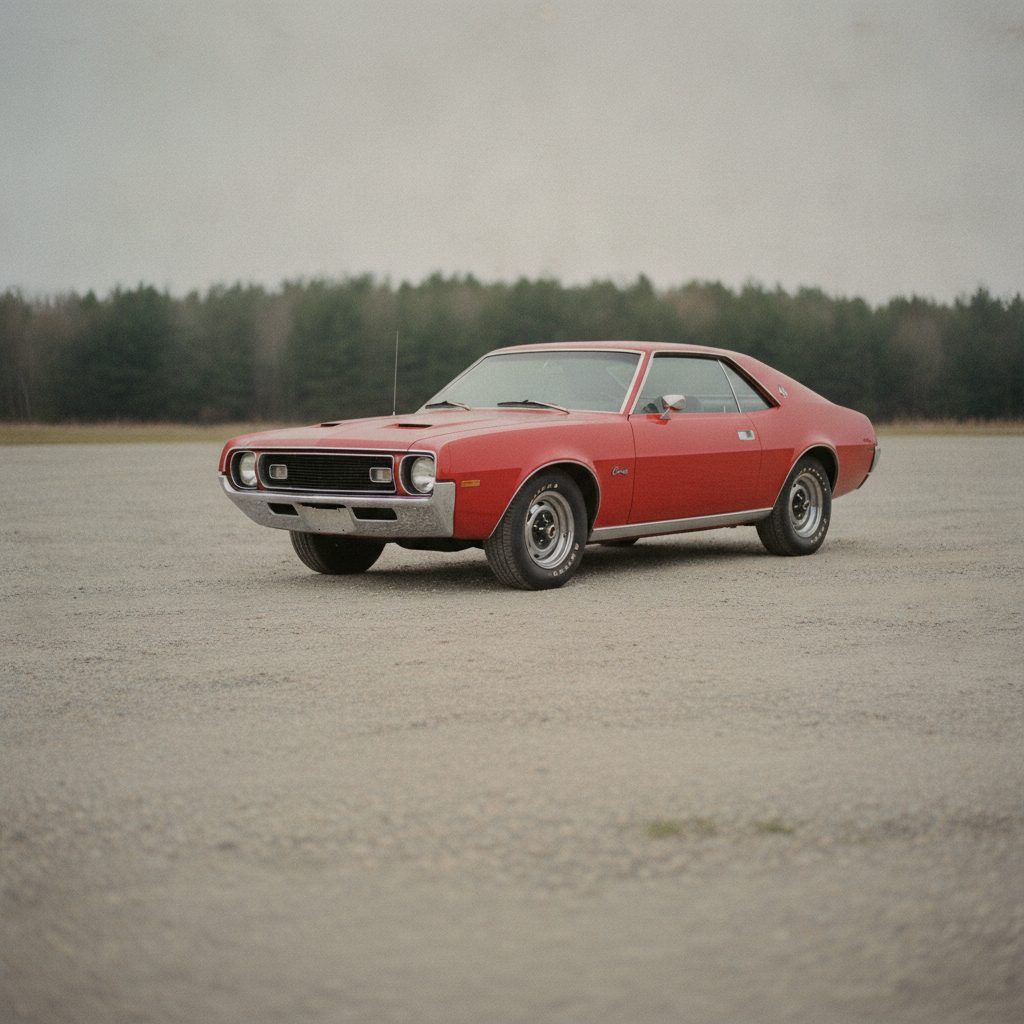
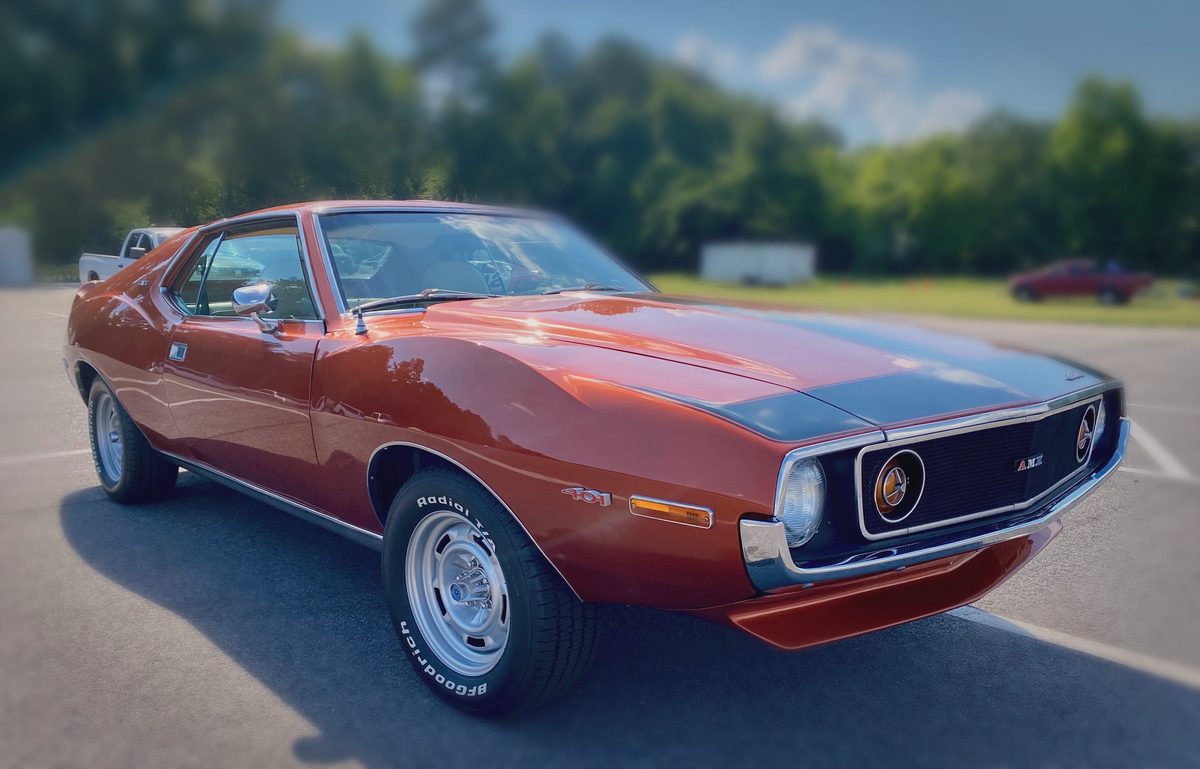
American Motors never had the budget of the Big Three, so it did something they would not: a short-wheelbase, two-seat muscle car. The AMX was a gamble, and for years the market ignored it. The market has finally stopped ignoring it.
By the late 1960s, American Motors was the smallest company in an industry that punished small. It could not outspend Ford or General Motors, and its Rambler image was economy-car sensible at the exact moment the market wanted loud. The Javelin, new for 1968, was Kenosha's answer to the Mustang and the Camaro, a legitimate pony car with clean lines and real V8 options. The AMX was the harder swing. AMC pulled twelve inches out of the Javelin's wheelbase, deleted the back seat, and landed at 97 inches, a full inch shorter than a Corvette.
That made the AMX, launched in February 1968 as a mid-year surprise, the only steel-bodied two-seat American production car on the market. It was not quite a sports car and not quite a muscle car, and AMC leaned into the ambiguity rather than fighting it. The AMX sold for well under Corvette money while offering big-inch V8 power in a body that weighed roughly 3,100 pounds. For a company that could not afford a clean-sheet halo car, shortening an existing platform was the entire budget, and it worked better than anyone in Detroit expected.
Every AMX left the factory with a V8. From 1968 through 1969 the base engine was a 290 with a four-barrel carburetor, a 343 sat in the middle of the ladder, and the AMX 390 sat on top, rated at 315 horsepower and 425 lb-ft of torque. The 390 was a serious piece for the money, built with a forged steel crankshaft and forged connecting rods at a time when plenty of competitors were casting theirs. For 1970 the base engine grew to a 360, and a revised 390 carried a 325 horsepower rating.
The box to check on the order form was the Go Package, which bundled the hardware a fast driver actually needed: heavier suspension, power front disc brakes, wider performance tires, and upgraded cooling, with a Twin-Grip limited-slip differential available to put the power down. A 390 four-speed car with the Go Package was the sharpest tool in the AMC catalog, and period road tests put the big-engine cars deep into the fourteens in the quarter mile, right in the hunt with rivals that carried far bigger marketing budgets. The smaller engines made for lighter, cheaper AMXs, but the 390 is the engine the model is remembered for.
From 1968 to 1970, exactly two American production cars seated two people: the Corvette and the AMX. They solved the same problem from opposite directions. The Corvette was fiberglass, independent-suspension sophisticated, and priced accordingly. The AMX was steel, solid-axle simple, and meaningfully cheaper. Inside, it kept things honest, with two buckets, a full set of gauges, and a shifter right where your hand fell. Cross-shopping the two was rarer than the spec sheets suggest, but the comparison gave AMC something its ad budget could never buy, because every story written about America's two-seaters had to put the underdog from Kenosha in the same sentence as the Corvette.
AMC also bought credibility the old-fashioned way, by going fast in public. In February 1968, land speed record holder Craig Breedlove took AMXs to a closed course and set 106 speed and endurance records, and the headlines did more for the new car's reputation than any brochure could have. The message was simple: the little company's short car was not a styling exercise.
The company that could not afford to gamble built the boldest car of the bunch.
The two-seat AMX lasted three model years, and the totals stayed small: 6,725 cars for 1968, 8,293 for 1969, and 4,116 for 1970, a shade over 19,000 in all. For scale, Ford could move that many Mustangs in a strong month. For 1970 the AMX received a new front end with a power blister hood, available ram air, and the 360 as its new base engine. Details like grilles, stripes, and interior trim shifted every year, which is why AMX people talk in model years the way Corvette people talk in generations.
After 1970, AMC folded the AMX name into the Javelin line as a top trim, which is why collectors are precise about the words. A 1968 to 1970 AMX is the two-seater. Everything after is a Javelin AMX, a different car with its own following. The short run and modest totals mean the genuine article was never common, and decades of attrition on an affordable performance car did what attrition always does. Survivors are a fraction of an already small number.
For decades the market treated the AMX as a footnote. With a 390 V8 in a light body it was quick and genuinely different, but orphan-brand status kept prices well behind comparable Camaros and Mustangs. That gap has been narrowing. Rarity plus rising respect means the underdog is finally climbing, and the move looks broad-based rather than speculative, which is the healthy kind of climb. The cars leading it are the ones you would expect: documented 390 Go Package cars, four-speeds, and unrestored originals with a paper trail.
Part of the appeal is that AMC's nothing-to-lose streak produced cars with genuine character, the same instinct that gave the world the one-year-only Rebel Machine. Collectors who already own the obvious blue chips are shopping for stories now, and the AMX has one of the best in the era. There is a whole corner of the hobby built around Kenosha iron, and our AMX hub follows all of it.
The rules for buying one are the rules for any low-production muscle car, amplified. Documentation matters more than paint, because AMC-specific trim and body parts enjoy nowhere near the reproduction support that Mustang and Camaro owners take for granted, and a complete, correct car is worth a real premium over a project for exactly that reason. Verify the engine and drivetrain before believing the ad, walk away from stories that cannot be papered, and buy the best-documented example the budget allows. The good news is that the AMX community is small, knowledgeable, and generous with reference material, so an honest car is not hard to confirm.
AMC built 19,134 two-seat AMXs over three model years: 6,725 for 1968, 8,293 for 1969, and 4,116 for 1970. After 1970 the AMX name moved to a trim level on the four-seat Javelin, so the true two-seater run ended after just three model years.
Every AMX carried a V8. From 1968 to 1969 the lineup ran from a base 290 with a four-barrel carburetor through an optional 343 to the top AMX 390, rated at 315 horsepower and 425 lb-ft of torque. For 1970 the base engine became a 360 and the revised 390 was rated at 325 horsepower.
It is honestly both. The two seats and the 97-inch wheelbase argue sports car, while the 390 V8, the solid rear axle, and the straight-line manners argue muscle car. AMC marketed the AMX as its own category when it was new, and collectors still treat it as a class of one.
The direction has been favorable. AMX values trailed comparable Camaro and Mustang money for decades, and that gap has been closing as collectors chase rarity and originality. Documented 390 Go Package cars lead the market. Buy condition and paperwork first, and treat any appreciation as the bonus rather than the plan.
The muscle world, every morning. Auctions, builds, reveals. Free.