A Real GTO Judge Just Set a Record
A documented, numbers-matching 1969 GTO Judge crossed the block for money that reset the top of the market.
A documented, numbers-matching 1969 GTO Judge crossed the block for money that reset the top of the market.
Provenance is everything at the top of the market, and this 1969 Judge had all of it: documentation, matching numbers, and a history that checked out. When the hammer fell, it set a new high-water mark for the model.
The Judge was Pontiac's loud answer to a loud era: Ram Air power, wild stripes, and a name that dared you to argue. Clean, correct examples were always valuable. Verified ones are now blue chip, and this sale drew the line between the two in permanent ink. To understand why one car can reset an entire market, you have to understand what the Judge was, how few were built, and why paperwork now outranks paint.
The GTO wrote the muscle car formula in 1964: take a midsize body, drop in a big engine, and sell speed to the young and the brave. By 1968, though, the formula was under siege. Plymouth's Road Runner undercut the GTO on price, every division in Detroit had a stripe-and-scoop package of its own, and Pontiac needed an answer that could not be ignored. It arrived in December 1968 as a $332 option package on the GTO, named for a running gag from the television show Laugh-In: Here Come de Judge.
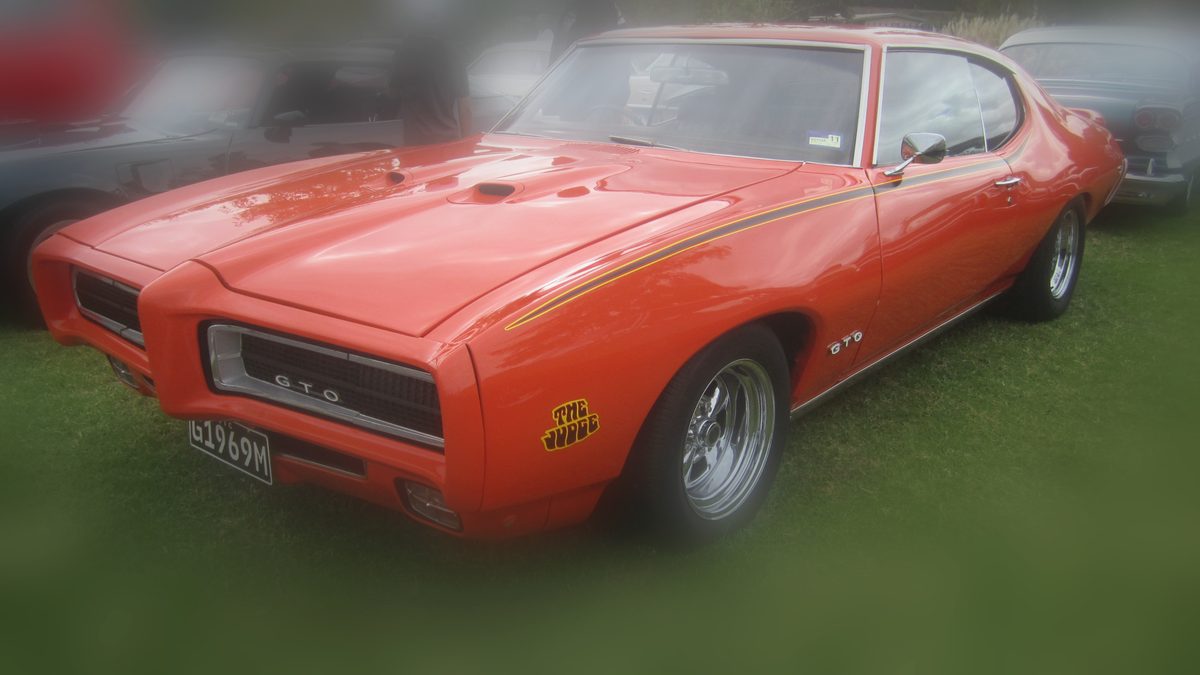
The package had been floated internally as a budget stripper to fight the Road Runner on price. What actually reached showrooms went the other way entirely. The Judge got the Ram Air III engine as standard equipment, a 60-inch rear spoiler, a blacked-out grille, Rally II wheels without trim rings, tri-color stripes, and decals that made sure nobody mistook it for a plain GTO. The earliest cars all wore Carousel Red, a paint so loud it reads as orange in most light, before Pontiac opened the color chart to the rest of the range.
Pontiac built 6,833 GTO Judges for 1969, a thin slice of total GTO production, which topped 72,000 cars that year. Just 108 of those Judges left the factory as convertibles. Attrition has done the rest of the work in the decades since. These were affordable performance cars sold to young drivers, and street racing, winters, and hard miles thinned the herd badly. Cars that survived with their original drivetrains and an unbroken paper trail are rarer still, and that is the small pool a record-setting sale swims in.
Rarity alone never made a car blue chip, though. Plenty of low-production muscle sits quietly in the middle of the market. What separates the Judge is the combination: low production, first-year status, a cultural footprint far bigger than its sales figures, and an engine package that backed up every claim the stripes made.
Every 1969 Judge came standard with the 400 cubic inch Ram Air III, rated at 366 horsepower and breathing through functional hood scoops. The record car carried exactly that engine with a four-speed behind it, the drivetrain combination collectors chase hardest. The optional Ram Air IV raised the official rating to just 370 horsepower, a number nobody believed in 1969 and nobody believes now. Round-port heads, a more aggressive cam, and better breathing made the IV the serious hardware, and the tiny gap between the two ratings was a wink aimed at the insurance industry.
Ram Air IV Judges are dramatically rarer and trade in their own stratosphere when documented examples surface. But the sale that matters here makes a different point: a documented, matching-numbers Ram Air III car needs no apology at the top of the market. Condition, correctness, and provenance did the heavy lifting.
At the top of the market, the paperwork is worth as much as the paint.
Buyers are paying up for cars they do not have to question. The premium for real documentation over a good tribute has never been wider, and this sale proved it. Pontiac Historical Services can supply the original billing history for a given VIN, which means a real Judge can be proven on paper rather than argued over a fender. Matching numbers, date-coded components, and an ownership chain that checks out turn a good car into a bankable one, and auction bidders now treat that paperwork as part of the car itself.
The Judge is especially sensitive to this because it was an option package, not a separate model. A base GTO, or even a LeMans, can be dressed as a Judge with a catalog of reproduction parts and a weekend of decal work. There is nothing wrong with an honest Judge tribute built for the street, but the market pays for certainty, and certainty lives in the documents.
One sale never rewrites a market by itself, but it does reset the reference point. Every documented Judge that comes to market from now on will be priced in this car's shadow, and every seller of an undocumented car or a tribute just watched the gap above them widen. That is the pattern across the top of the muscle car market in recent years: verified cars pull away, and everything else holds or drifts.
It also fits the larger story we have been covering as the barn-find era winds down. The famous barns are mostly empty, the undiscovered cars are mostly discovered, and what is scarce now is not metal but proof. The money adjusted to that reality before the headlines did.
For owners, the practical takeaway is simple: paperwork is now a restoration item. Ordering the Pontiac Historical Services packet, hunting the original build sheet, and archiving every receipt adds real value, the same way a correct repaint once did. For buyers, the discipline runs the other way. If the story cannot be proven, price the car as if it cannot be proven.
In period, the Judge fought the Road Runner, the Chevelle SS 396, and the Cobra Jet Mustangs on the street and in the magazines. Some rivals were quicker on paper, and the Chevelle would land its knockout LS6 punch a year later. But none of them matched the Judge's mix of attitude, scarcity, and Pontiac's talent for theater, and the collector market has ranked the era accordingly. It is the difference between being a fast car and being a moment, and the Judge was both. The loudest car in the room in 1969 is still the first one collectors mention.
Pontiac built 6,833 GTO Judges in 1969, and only 108 of them were convertibles. That is a small fraction of the more than 72,000 GTOs Pontiac sold that year. Documented, matching-numbers survivors are a far smaller group still, which is why verified examples are the ones setting records at auction.
The standard engine was the 400 cubic inch Ram Air III V8, rated at 366 horsepower with functional hood scoops and a choice of four-speed manual or automatic. The optional Ram Air IV carried a 370 horsepower rating with round-port heads and a hotter cam, and both figures were considered conservative.
The Judge was a $332 option package on the 1969 GTO. It added the Ram Air III engine, rear spoiler, stripes, blacked-out grille, Rally II wheels, and Judge decals. A typical car stickered near $3,161, which made the Judge one of the strongest performance values of the entire muscle car era.
A numbers-matching Judge retains its original engine, transmission, and rear axle, verified through date codes and stampings that align with the VIN and factory build documents. Pontiac Historical Services documentation, which reproduces the original billing history, is the accepted standard for proving that a Judge left the factory as one.
The muscle world, every morning. Auctions, builds, reveals. Free.