The Daytona Wing War
Why Dodge bolted a two-foot wing and a nose cone onto a Charger. And why those cars are worth seven figures now.
Why Dodge bolted a two-foot wing and a nose cone onto a Charger. And why those cars are worth seven figures now.
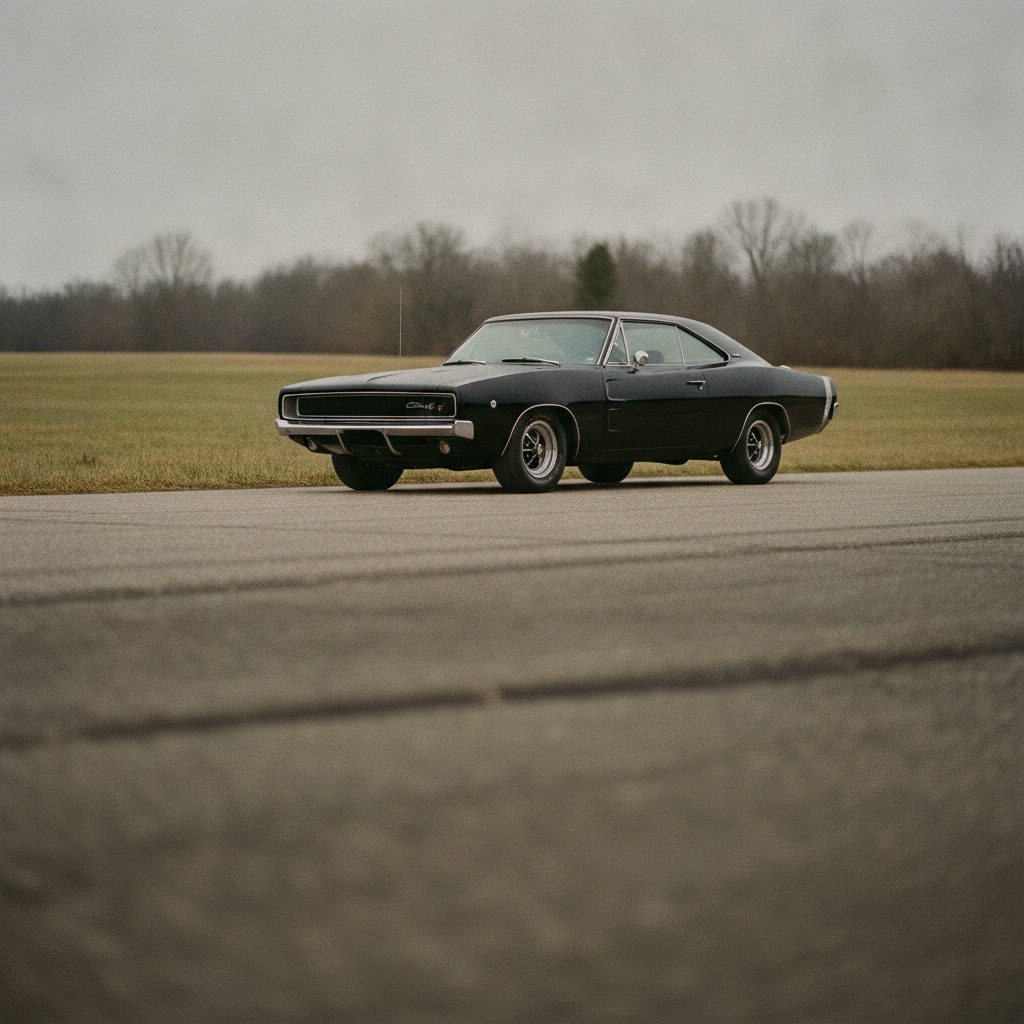
The 1969 Charger Daytona was a homologation special born from NASCAR desperation: a wing you could see over the roof and a nose designed in a wind tunnel. It looked absurd. It also worked.
No American car has traveled a stranger road from showroom embarrassment to blue-chip trophy. The wing cars were nearly unsellable when new, discounted on dealer lots while ordinary Chargers moved around them. Today, verified Daytonas trade past a million dollars, making them among the most valuable American cars ever built. Understanding how that happened means going back to the fastest, strangest arms race stock car racing ever saw.
In 1968 and 1969, NASCAR was an aerodynamics war. Ford rolled out the sleek Torino Talladega and Mercury's Cyclone Spoiler II, droop-nosed fastbacks that cut through the air, and Chrysler's teams suddenly could not keep up. The standard Charger, gorgeous as it was, behaved badly at speed. The tunneled grille acted like a parachute and the recessed rear window created lift right where the car needed grip. The desperation was real: on the superspeedways, aerodynamics decided races, and no engine could overcome a bad shape. Winning on Sunday still sold cars on Monday, and Chrysler was losing its Sundays.
Dodge's first fix was the Charger 500, with a flush grille and flush rear glass. It helped, and it still was not enough. So the engineers stopped compromising. Working from wind tunnel data with the outside firm Creative Industries, they grafted on an eighteen-inch sheet-metal nose cone and a towering rear wing, and the Charger Daytona was born. NASCAR's homologation rules required at least 500 street examples, so Dodge built them. Barely.
Everything strange about the Daytona has an engineering reason. The steel nose cone smoothed airflow and added front downforce, with pop-up headlights preserving something like street usability. The rear-facing fender scoops relieved pressure and cleared the tires. And the wing stood roughly two feet tall for two very practical reasons: it put the airfoil up into clean, undisturbed air, and it left the trunk lid free to open. Even the pillars and backlight got attention, with a flush rear window smoothing airflow the standard body churned up. Nothing on the car was styling for its own sake, which is precisely why the styling became immortal.
The package was worth real speed where it counted, at Daytona and Talladega, the superspeedways where races were decided by stability at the top end. On the street, the nose added more than a foot of length and the wing drew stares in every parking lot, but the hardware underneath remained essentially Charger R/T. The wildest-looking car in America was surprisingly ordinary to live with.
Dodge built just 503 Charger Daytonas for 1969, the minimum needed to satisfy NASCAR. Roughly 70 carried the 426 Hemi; the rest ran the 440 Magnum. And then they sat. Buyers in 1969 wanted a Charger that looked like a Charger, not a science experiment with a beak. Dealers discounted them, and period stories tell of wing cars lingering unsold for months while ordinary R/Ts moved off the same lot.
The years that followed were not kind. Cheap, unloved wing cars got driven hard, crashed, customized, and parted out. By the time the world realized what they were, a meaningful share of the 503 was gone, and the survivors became the objects of one of the great treasure hunts in the hobby.
Street Daytonas came standard with the 440 Magnum, rated at 375 horsepower, with the 426 Hemi as the rare and expensive option. Beyond the nose and wing, the cars were fully road-equipped Chargers, available with automatics and creature comforts, which is part of their charm. The buyer got a NASCAR homologation device that could idle through a burger stand. Roughly one in seven ordered the elephant engine, creating the Hemi Daytona, the rarest and most valuable combination of them all.
Unsellable in 1969. A million-dollar car today.
The confusion is understandable, but the two wing cars are different machines. The Daytona is a 1969 Dodge, built on the Charger. The Superbird is a 1970 Plymouth, built on the Road Runner, created in part to bring Richard Petty back to Plymouth. By 1970 NASCAR had raised the homologation bar, so Plymouth built far more of them, roughly 1,900 cars by most counts, nearly four times the Daytona's run.
Visually, the Superbird wears a vinyl roof on every car, a differently shaped nose, and a wing with more sweep to its uprights. Purists will tell you the Daytona was the cleaner aerodynamic job, and the market has agreed for decades: the rarer Dodge consistently brings more money than its Plymouth cousin, though both have left the realm of ordinary collecting.
On track, the wing cars delivered immediately. A Daytona won the model's very first outing at the inaugural Talladega 500 in September 1969, and in March 1970 Buddy Baker took one past 200 mph at the same track, the first time any car had broken that barrier in NASCAR competition. The sanctioning body had seen enough. For 1971 it restricted the aero specials to engines of roughly 305 cubic inches, less than half their intended displacement, a handicap nobody could race around. The wildest era in stock car design was legislated out of existence barely two years after it began, which only fed the legend.
The market inversion is total. The car dealers could not give away is now the crown jewel of any Mopar collection. Verified, documented Daytonas trade past a million dollars, with Hemi cars at the top of the pyramid and even rough projects bringing serious money. Documentation decides everything at this altitude: broadcast sheets, fender tags, and known ownership history separate real wing cars from tributes. For the rest of the Charger story, from the wildest modern street builds to the full model history, start with our Charger hub.
That trajectory is the ultimate proof of the oldest collector rule: the cars nobody wanted new become the cars everyone wants later, provided they were built for a reason. It is also why the wing car's silhouette shows up on posters, diecasts, and tattoos more often than cars that outsold it a hundred to one. The Daytona was built for the best reason of all. It was built to win.
Dodge built 503 Charger Daytonas for the 1969 model year, the minimum required to homologate the car for NASCAR competition. Roughly 70 of them carried the optional 426 Hemi, while the rest used the standard 440 Magnum. Attrition has since made surviving documented cars significantly rarer.
The Daytona is a 1969 Dodge based on the Charger; the Superbird is a 1970 Plymouth based on the Road Runner. The Superbird has a vinyl roof, a different nose profile, and more swept-back wing uprights, and Plymouth built roughly four times as many, which is why Daytonas bring more money.
NASCAR did not ban them outright. For 1971 it restricted the aero specials to engines of roughly 305 cubic inches, less than half their intended displacement, which made them uncompetitive overnight. The rule was aimed squarely at the Daytona, the Superbird, and Ford's aero cars, and it worked.
Verified, documented examples trade past a million dollars, and exceptional Hemi cars have gone well beyond that. Values depend heavily on engine, documentation, originality, and history. Even incomplete project cars command strong six-figure money, because only 503 were built and the supply of real wing cars only shrinks.
The muscle world, every morning. Auctions, builds, reveals. Free.